
 Launch
Fixed-bid budgeting
Fixed-bid budgeting is the most common contractual approach for vendors to be compensated for work on a client project. It can be a tricky balancing act to offer a bid that's not too high that the project is lost to a more competitive bid. But also not too low so that you lose money. missionX can help you both estimate and track fixed-bid projects...

About fixed-bid projects
In a fixed-bid project, the client and the service provider agree upon apredefined budget, scope, timeline, and deliverables before the project begins.
The service provider is responsible for completing the project within these predetermined parameters.
Unlike more flexible models (such as Time and Materials), where costs are based on actual time and resources used, fixed bid contracts set a specific price regardless of the actual costs incurred during the project.
This model is often preferred for projects with a clearly defined scope and where minimal changes are expected during the project lifecycle.
Benefits of fixed-bid
Reasons for opting for fixed-bid contracts:
Budget certainty
Fixed bid contracts offer a clear, predefined budget, which is particularly appealing for clients with limited or strictly allocated financial resources. It allows for easier financial planning and reduces the risk of budget overruns.
Simplicity and reduced oversight
In fixed-bid projects, the client's involvement in day-to-day project management is typically minimal. This can be advantageous for clients who prefer a hands-off approach or lack the time/expertise to actively manage the project
Risk transfer to service providers
Fixed bid contracts shift the risk of cost overruns and project complexities to the service provider. Clients who want to minimize their exposure to project risks find this attractive.
Suitability for well-defined projects
For projects with a well-defined scope and predictable requirements (e.g., building a specific feature or replicating an existing solution), fixed bid contracts can be more efficient and straightforward.
Clear deliverables and deadlines
These contracts come with well-defined deliverables and timelines, providing a clear structure and end goal for the project. Meeting specific deadlines is critical in such cases
Accurate estimation is key
In summary, fixed-bid budgeting provides clients with predictability and cost control but vendors must be very carefull to estimat the project correctly. Too high and you may lose the project, too low and you will end up losing money.
missionX can help you stay on budget once a project starts but you can also use Budget pro and propsoals to help you estmate the project before you bid.
Applying fixed-bid
For all projects (except MX-Gantt) the quickest and easiest way to create a fixed-bid budget is by specifying fundable milestones in Budget pro.
Please note that although fundable milestones break down the total budget into milestones for invoicing and financial projections, it does not show how we arrived at the total budget. That's where estimation comes in.
Estimating the project involves defining all things that can incur a cost and generate revenue (if project is billable) Line-items and project roles can help you arrive at a cost estimation. Once you have your estimated cost you can define your milestones by your total costs + your desired profit margin. Proposals in missionX are designed to help with this.
For MX-Gantt, it is strongly advised to estimate the project from within your project plan (WBS). You can create milestones there and add a cost to them. This will then keep your Earned Value reports accurate and invoicing more precise.
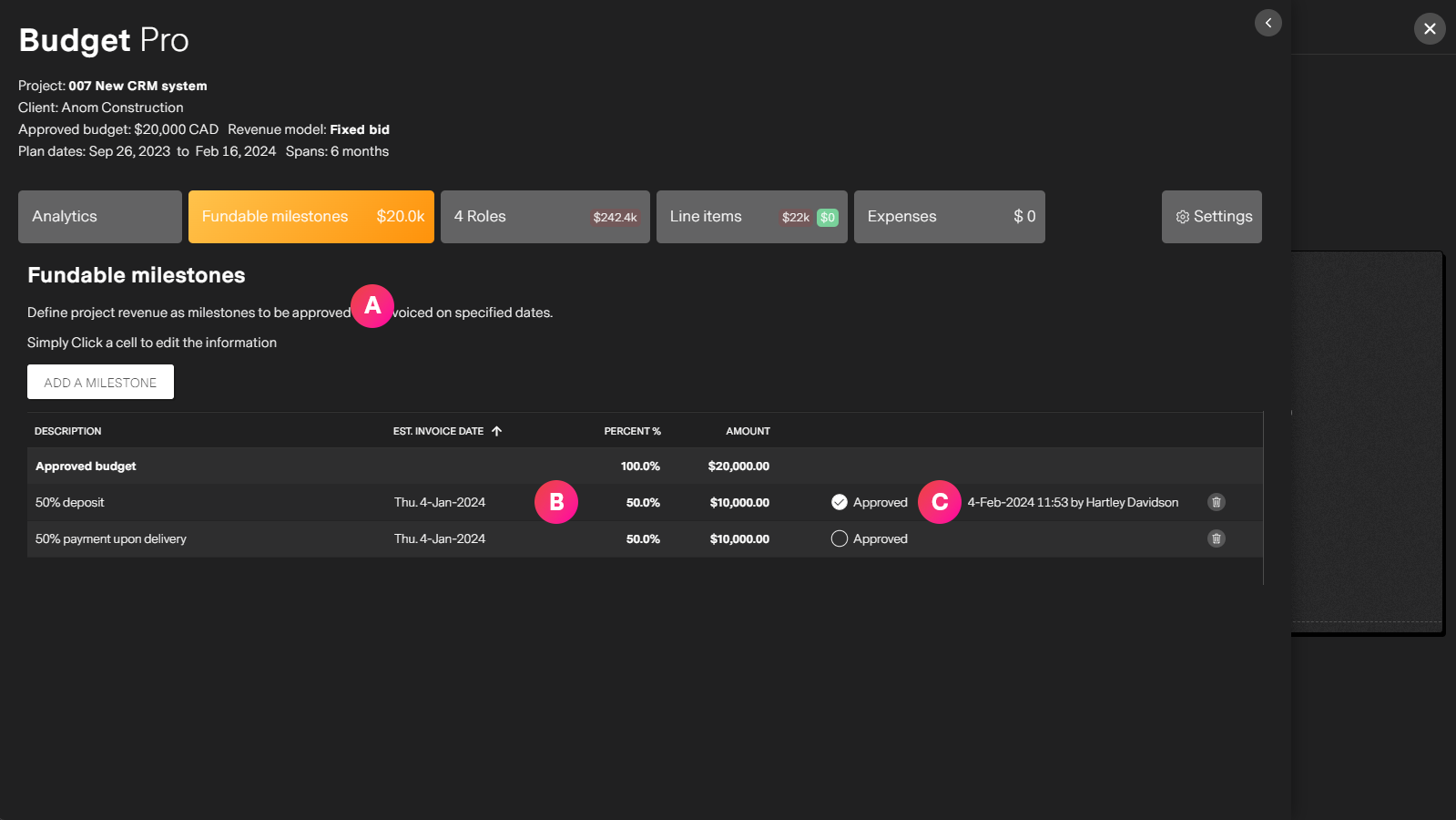
| Label | Feature | Description |
| A | Add button | Adds a fundable milestone to your project |
| B | Fundable milestones | You can change title, invoice date (when the milestone is to be realized), percent of total budget or manually enter an amount. |
| C | Approve | By approving milestones the project manager can signal that this milestone is ready to be invoiced. |